
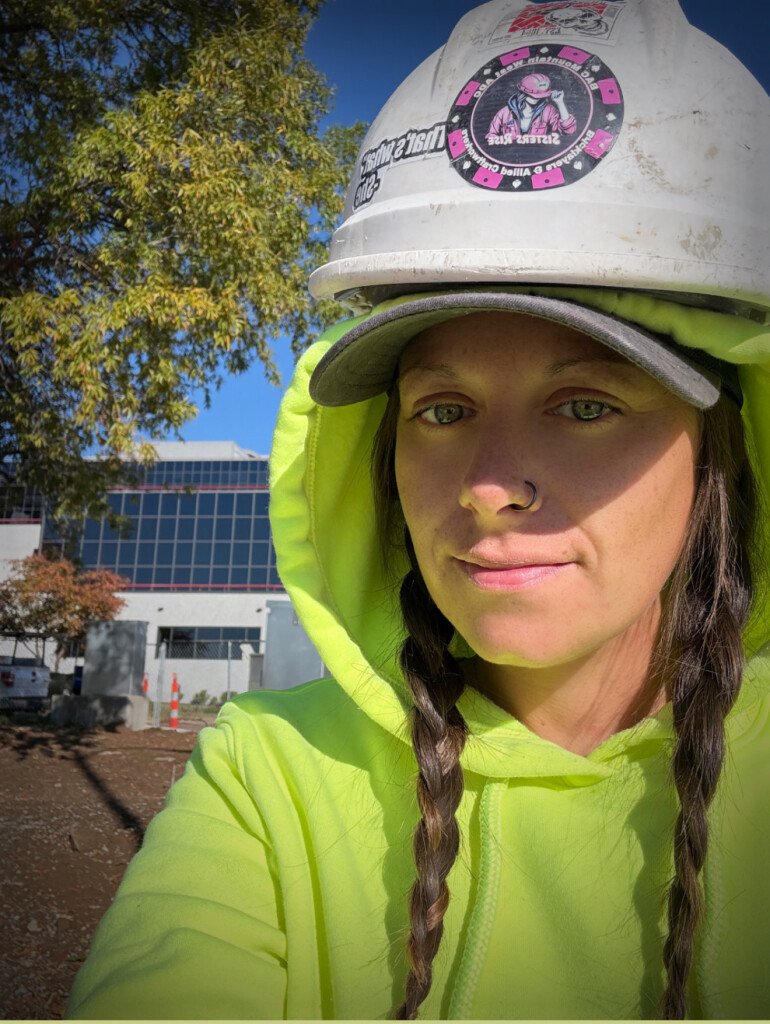
What is your name and occupation?
My name is Samantha Downey, and I’m an apprentice bricklayer.
What were you doing before you became a bricklayer?
I had a few factory jobs, but there was a period of about three years when I wasn’t working—right before my daughter was born and for some time after.
How did you find out about the bricklayer apprenticeship program?
I knew I wanted a hands-on career in the trades, so I called my union hall. They connected me with a training center where I joined a pre-apprenticeship program that taught me the basics. That training led to me receiving a letter of intent to hire from the union.
Could you describe your experience in the pre-apprenticeship program?
It was really cool. The instructors at my training center were great. They treated me just like everyone else, no different from the male students. In St. Louis, there are only two women bricklayers in our local, so it means a lot to feel supported as a woman in this trade.
After completing the pre-apprenticeship program, you moved into the apprenticeship program with the bricklayers union. Can you tell me about that?
Yes. Contractors visit the apprenticeship program to see our work firsthand and decide who they’d like to offer a letter of intent to—and I was offered one.
What’s something about your job that surprised you once you started?
At first, I thought that my work would involve just bricks, but masonry has a much wider scope than what I’d first imagined. We work with blocks, big heavy stones, and panels of granite. There’s such a varied assortment of materials.
Also, I was surprised about how much I loved it once I started doing the work.
Would you recommend this field to another woman?
I would absolutely recommend it to another woman, and I actively encourage women to explore the trades. I am also a part of the Missouri Women in Trades organization. We mentor women in the trades and offer support to help retain them in their field.
Women should just go for it because it’s not as scary as they might think. The biggest hurdle is thinking you’re not good enough to do it. Everybody starts somewhere, so don’t be intimidated if you don’t know everything at the beginning.
I see many women who are interested in the trades, but it seems like bricklaying is one of the last options they consider. It can seem intimidating to work with heavy materials like blocks. However, I’m not especially strong or tall, and I do it. The body adapts quickly so that what’s heavy today is not going to be heavy in two weeks.
What do you think is the future of your field?
These days, customers have a lot of options. I think we should work a little harder to show them the value of durable materials like bricks and blocks, rather than alternatives like aluminum siding or sheet metal for building out something like exterior walls, for example.
I also think we’re entering a time when much of the older masonry work requires maintenance. Bricks that have stood for many decades now need repair or replacement, which means there are plenty of challenging pointing jobs available to meet this demand.
What advice would you give another woman who wants to follow in your footsteps?
Have the mindset that you can do it. Even if it feels like no one is in your corner, use that as motivation to prove them wrong.
Women should know that a lot of states have organizations that actively support women entering into nontraditional trades.
Is there anything you’re excited about right now?
I wake up every day feeling excited because I’ve come such a long way—overcoming addiction and leaving an abusive relationship. Getting into the trades changed everything for me. Through my career, my recovery, and my involvement with Missouri Women in Trades, I’ve found purpose and empowerment. I’m proud to be building a stable, fulfilling life for myself and my kids, and to support and inspire women and others in recovery to see that this kind of life is possible. My career has truly come full circle and transformed my life.
As someone who has overcome addiction, I’m passionate about supporting other women in recovery. I got involved with Missouri Women in Trades, and now I have a strong network of people around me who are encouraging and lift each other up when it’s needed.
Interview conducted, transcribed, and written by Marlynda Arnett, Program Innovation Leader for West Virginia Women Work.